
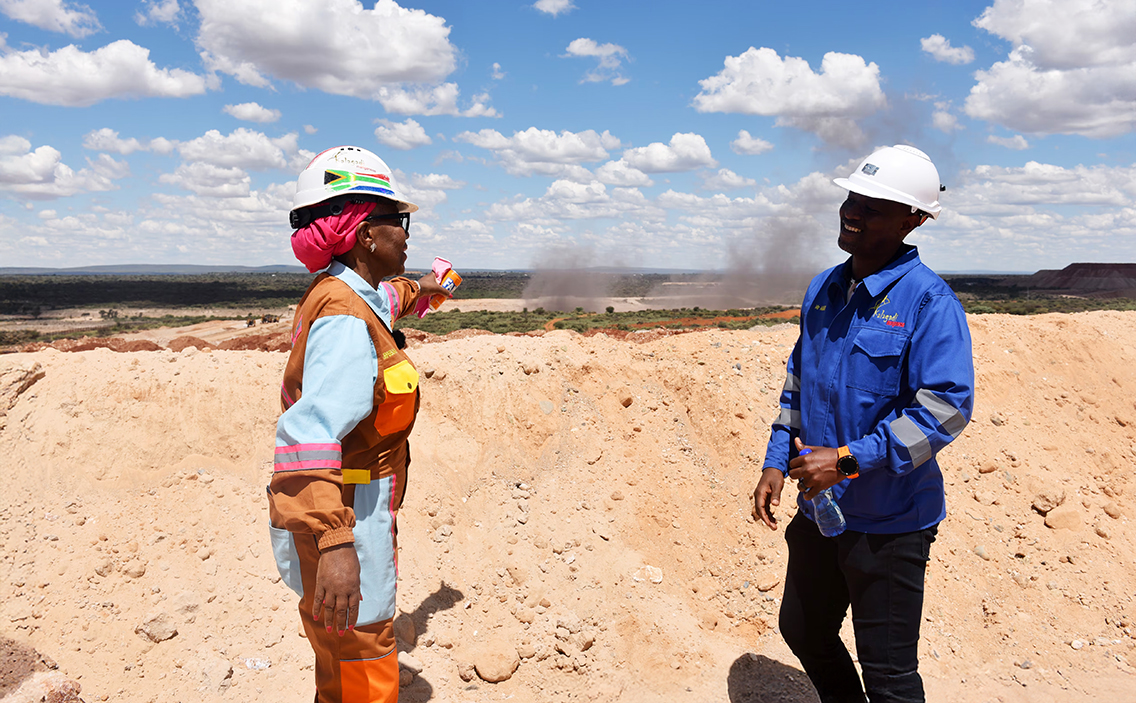
In the rough world of African mining there is tough, very tough, and then there is Daphne Mashile-Nkosi. The flinty queen of manganese has been through the mill: poverty; prison; police batons; gnawing pain of loss, corporate theft and the persistent pinpricks of casual misogyny.
“For steel to be hard and beautiful and shiny it has to go through fire! Maybe I had to go through the pain I went through for me to achieve what I have achieved,” she says.
Daphne Mashile-Nkosi is a maverick miner of manganese in the wilds of South Africa’s Northern Cape province as the world clamours for control of minerals.
South Africa accounts for 37% of world production – and Mashile-Nkosi hopes to boost that further at the Kalagadi Manganese mine in Hotazel, just north of Kuruman. This year production at her mine is ramping up to 200,000 tonnes of manganese a month thanks to a new open pit operation, complementing output from the underground mine that opened in November.
The open pit is expected to run for the next 18 years, Mashile-Nkosi says, producing up to 2m tonnes per annum and creating 400 new jobs. The underground operation is set to run until 2055.
“When you talk about industrialising a country it is projects like this that you need to look at. We think this year and next year we will see Kalagadi growing by leaps and bounds,” she says.
The mine’s production is sent in 104-wagon trains more than a thousand kilometres to the Coega port near Gqeberha (formerly Port Elizabeth) in the Eastern Cape, on its way to hungry export markets in China and India. Most of this manganese is alloyed with iron to make toughened steel for construction; about a tenth of it ends up in batteries, mostly for electric vehicles.
The railhead is inside the mine and has a conveyor belt which can fill the wagons, on a good day, in less than three hours. The mine is testing a train with 135 wagons. The plan is to ramp production up to 400,000 tonnes a month in April, with a production target of 4m tonnes in 2026.
Beneficiation
The next task for Mashile-Nkosi is to secure the mine’s beneficiation operation. Beneficiation is a popular buzz word among South Africa’s political elite, summarising the idea of bucking the colonial legacy of merely exporting cheap raw materials in favour of squeezing more value out of resources before they leave Africa.
“For me beneficiation is the key to investment. It means more jobs and high-end jobs that will attract more direct foreign investment,” she says. At the heart of this is the mine’s sinter plant, which uses furnaces to turn the low-grade manganese ore – containing around 27% manganese – into higher-grade sinter with up to 46%. Mashile-Nkosi says the premium for the higher-grade is a healthy $1 a tonne. The mine is looking to ramp up output from the sinter plant beyond its capacity of 2.4m tonnes.
“We don’t have enough capacity, so we will have to see if we can thrash the sinter plant a bit,” she says.
There are more ambitious plans afoot. Over the next two years the mine is looking to set up two mighty furnaces to process manganese ore into high-carbon ferro manganese for cars and heavy machinery.
A fly in the ointment is the scarcity and cost of electricity. Running the furnaces will require 16 MW – enough electricity to power around 16,000 homes in South Africa.
Mashile-Nkosi says she has had encouraging meetings about supply and cost with the national power producer Eskom. “Our biggest concerns are logistics and electricity pricing,” she says.
A controversy casting its shadow over Kalagadi mine is a long-standing dispute over a debt of billions of rands with South Africa’s Industrial Development Corporation (IDC), the African Development Bank and the South African bank ABSA. The state-owned IDC, which holds 20% of the company, tried to put Kalagadi into “business rescue” in 2021, arguing that it lacked liquidity and was failing to service debt. This year Mashile-Nkosi is more sanguine about this threat after a series of recent talks with creditors.
“We are trying to talk to each other because, at the end of the day, we need each other. We are no longer interested in fighting. We are interested in building the country… What is good about the IDC is that they have new management and a new board and therefore they have fresh perspective about the baggage that was there.”
In June South Africa’s Business Day reported that the debts have ballooned to about 8.5bn rand ($530m), including interest accrued so far, and that the debt dispute would head for arbitration.
Long path to the top for Mashile-Nkosi
The battle for success is never complete, but Mashile-Nkosi speaks with pride about the development of the mine and the way in which she has become a leader in a traditionally white and male dominated industry.
“This is the best and most beautiful mine underground. We are very proud of what we have achieved. I am very proud of the fact that I am a female. I am very proud of the fact that some people thought I couldn’t make it; I have done it! I want millions of women and millions of the young to look at this and think they can do it.”
This outlook has emerged from deep, painful scars from struggle in life and business. “Don’t expect anyone to open any doors for you but break doors down for yourself. The world owes you nothing,” she says.
Mashile-Nkosi has learned this the hard way. One morning in 2010 her lawyers woke her with the news she had been kicked out of Kalahari Resources – the forerunner of Kalagadi Manganese. At first, she hoped it was someone’s idea of a sick joke. Along with two other directors, she had been struck off the database at the Department of Trade and Industry’s Companies and Intellectual Property Registration Office (CIPRO). She wasn’t even a shareholder any longer.
It was a crude corporate hi-jacking at the worst of times for Mashile-Nkosi. Just a few days before she had buried her husband Stanley, who died young following a botched throat operation.
Outside court, a crowd of journalists, bristling with microphones, bombarded her with questions. Her rise had been so low-key that many didn’t know who she was. The more she told her story, the more she felt that people doubted that she owned the mining assets in question. The rumour mill was cruel.
“Some were saying nasty things, like ‘you send a thief to catch a thief’! Others thought, she’s either corrupt or slept her way up to the top. I said to myself: ‘What did you expect? You got into a man’s world and changed the course of history’.”
In court, it was even more bizarre. It turned out she’d never heard of the man who had led the group that had struck her name from the shareholding. Sandile Majali had, it was alleged, connections to a number of high-ranking members of the ruling African National Congress party. Majali had never been connected to Kalahari, but overnight he apparently became one of its owners.
To cut a long court battle short; about a month after the striking off, the court ruled in favour of Mashile-Nkosi. Majali was arrested for fraud, then ordered to pay Mashile-Nkosi’s legal costs. Soon afterwards he was found dead in a Johannesburg hotel room.
Mining in her blood
For a fiery woman born into struggle, it is ironic that Mashile-Nkosi was born in a beautiful corner of north-west South Africa with a peaceful sounding name – Pilgrim’s Rest. The former gold-rush mining town, in Mpumalanga (formerly Eastern Transvaal province), is quiet as the grave on summer nights. To this day, Pilgrim’s Rest is frozen in time by the preservation of its quaint nineteenth-century wooden buildings built by avaricious European prospectors.
But when Mashile-Nkosi grew up in Pilgrim’s Rest, in the era of apartheid, it was tough and far from quaint for black people living on the fringes of the town.
Mashile-Nkosi was the youngest of four – two boys and two girls. Her grandmother worked all hours selling cakes and beer to help raise her 13 grandchildren.
Mashile-Nkosi’s mother, a seamstress, would go hungry to provide for her children. It was from her that Mashile-Nkosi learned the value of staying power and family. Her father, a general dealer who owned a football club, had little to do with his family. The young Mashile-Nkosi was outraged by the way he treated her bright and beautiful mother as a second-class citizen. It made her determined never to be abused.
Escape through education
Education was the way out of poverty and Pilgrim’s Rest. It was no easy road. Every morning she would put on her worn, second-hand uniform to walk many kilometres to school.
She lunched on peanut butter and powder milk from government packages for struggling families. The children at school mocked her for bringing soggy sandwiches for lunch.
But Mashile-Nkosi soared, even though she had to do washing for her neighbours to pay the fees so she could ace her final exams and move to Johannesburg.
That same year, history and liberation took a hand. In 1976, Mashile-Nkosi took part in the Soweto uprising that saw scores of children killed and hundreds injured in a bloody state crackdown. This fed her anger and led her to join the political underground.
The authorities deemed her a threat to state security and incarcerated her a number of times. Her first stint was nine months in solitary confinement. She says those desperate days honed her determination. The only way to speak to her comrade in the next cell was through the stinking toilet in the corner. She put her towel into the water and gradually soaked it up, wringing it out onto the floor, squeeze-by-squeeze. Her comrade in the next cell did the same and soon the two were talking, using the toilet as a telephone, with the filthy towel over their heads to muffle their whispers. When democracy came the struggle was far from over for Mashile-Nkosi.
“I was a performer at work but my big mouth wouldn’t allow it [to bear fruit]. I became a troublemaker because I asked the difficult questions,” she once told me.
“Number one: believe in yourself. I was not technical, I’m not a mining engineer, not a geologist. I’m not a metallurgist, I’m just me, an entrepreneur, that wanted to change the status quo,” she says.
Black empowerment
Mashile-Nkosi turned to mining – initially coal – in her entrepreneur’s dream of empowering black women – a move that demanded unshakeable self-confidence.
Given her path to the top, black economic empowerment (BEE) is a key interest of Mashile-Nkosi. She believes that the government’s BEE efforts can help to ensure the next generation have readier access to opportunities – but says access to finance must be reformed.
“They will take your proposal and give it to someone else and frustrate your efforts, if they’re in a position to actually fund you. They will frustrate you in such a way that they would want you to be on your knees so that they can say ‘go to so-and-so and get money’ because these are their friends… We’ve never really unpacked that; we have not even scratched the surface. BEE was a very good concept. But it was the implementation that was never monitored by government and never implemented properly.”
“The technical support that they have is [from] people who actually trained as technical people – but they have never been underground, never seen a shaft, or see it once every four or five years. And those are the people who sit and look at your financial model, which they don’t even understand, and ask you questions.”
What will Mashile-Nkosi’s own legacy of empowerment be? A few years back, a BBC Hardtalk interviewer asked her whether her efforts were filtering down to the poor. It was a question that stung and I ask it again.
“I am sitting now with 2,800 people [employed]. Most are local. We put food on the table and they contribute to the economy. The town of Kuruman has grown. Some came without qualifications, but the mine has trained them,” she says.
After scrapping her way to the top, Mashile-Nkosi says she still has several years of fight left in her.
“Succession planning is there – hopefully in the next three to four years I can retire,” she says with a smile. You can be sure it won’t be a quiet retirement.